Melting Space: Ricci flow and the Poincaré conjecture
By HarleyCoops (@HarleyCoops). Model: Kimi K3. Posted date unknown. Original post: https://github.com/HarleyCoops/KimiK3Manim
\documentclass[11pt]{article}
\usepackage[margin=1in]{geometry}
\usepackage{amsmath, amssymb}
\usepackage{xcolor}
\usepackage{hyperref}

\title{\textbf{MELTING SPACE}\\ \large Ricci Flow and the Poincar\'e Conjecture --- a cinematic mathematical discovery\\
\large verbose scene-by-scene prompt for Manim CE, true-3D, \LaTeX-rich}
\author{concept, storyboard and cinematography: Kimi K3 (reverse-reasoned)}
\date{}

\begin{document}
\maketitle

\noindent\textbf{Reverse reasoning chain (target $\to$ prerequisites):}
the Poincar\'e conjecture $\Leftarrow$ Ricci flow with surgery (Perelman)
$\Leftarrow$ the Ricci flow equation $\partial_t g = -2\,\mathrm{Ric}$ (Hamilton)
$\Leftarrow$ Ricci curvature $\Leftarrow$ Gaussian curvature of surfaces
$\Leftarrow$ ``shape'' up to stretching (topology) $\Leftarrow$ the sphere.
The film walks this chain \emph{forward}: what is a shape, how do you fingerprint it,
how do you melt it, what happens when it snaps, and how surgery finishes the proof.

\noindent\textbf{Novelty check:} no existing repo content is reused --- this is not
Euler, not Fourier, not polyhedra, not Pythagoras, not Newton fractals, not minimal
surfaces, not torus eigenfunctions, not Brownian motion, not Bak--Sneppen, not the
reverse-reasoning proof film. Topic never before touched in this repository.

\noindent\textbf{Global art direction:} true-3D throughout (\texttt{ThreeDScene}).
Deep void background \texttt{\#02020c}. Palette: sphere gold \texttt{\#ffd166},
curvature heat (cool-to-hot) \texttt{\#00e5ff}$\to$\texttt{\#ff2fb3}$\to$white,
saddle blue \texttt{\#4d7cff}, surgery red \texttt{\#ff4040}, caption cyan
\texttt{\#00e5ff}, text white \texttt{\#f4f1ff}. All surfaces are drawn as glowing
wireframe meshes (parametric polyline families with layered neon sheaths) with
curvature shown as thousands of colored vertex points --- no flat-shaded surfaces.
Every equation below is typeset on screen in \LaTeX{} and is mathematically correct.

\bigskip\hrulefill

\section*{Scene 1: The Question of Shapes --- \( \forall\,\gamma : S^1 \to M,\ \gamma \simeq \text{point} \)}

\subsection*{What You See:}

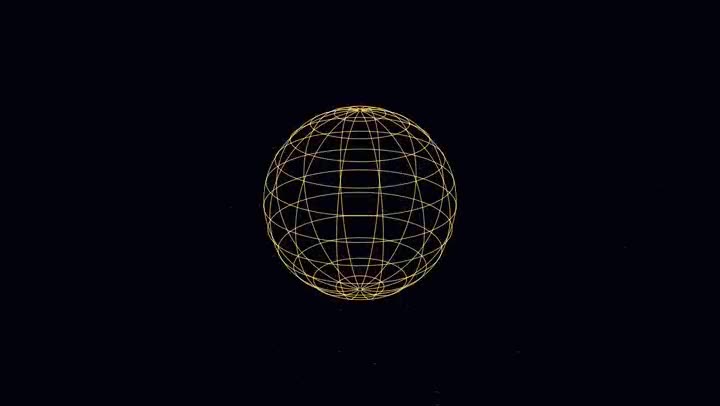
The void. A perfect golden wireframe sphere rotates slowly at center frame (camera:
$\phi = 68^\circ$, gentle drift, slow dolly-in). Then, one after another, it is
\emph{deformed} by invisible hands: it bulges into a \textbf{pear}, pinches into a
\textbf{dumbbell}, crumples into a \textbf{lumpy potato-blob} --- each a glowing
wireframe, each rotating in the same stately way. A caption typesets itself:
\texttt{// to a topologist, these are all the same shape}.

The test that tells shapes apart arrives: \textbf{rubber bands}. A glowing cyan loop
is lassoed around the sphere's equator --- and slides off over the pole, shrinking to
a point with a satisfying snap. Another loop, anywhere, same fate. Then a donut
appears (dim, ghostly, at the edge of frame just for contrast): a loop threaded
through its hole pulls tight and \emph{gets stuck} --- it cannot shrink away. Caption:
\texttt{// on a sphere, every loop lets go. on a donut, some never can.}

The grand question assembles in gold \LaTeX: \textbf{Poincar\'e, 1904} --- if a shape
is finite, has no boundary, and \emph{every} loop on it can shrink to a point,
\( \forall\,\gamma : S^1 \to M,\ \gamma \simeq \text{point} \), must it be a sphere?
The lumpy blob from earlier reappears beside the question mark, daring us.

\textbf{Timing:} $\approx 20$ seconds. \textbf{Particles:} 4 wireframe shapes
($\sim$40 curves each), 2 animated loops, ambient dust.

\subsection*{Concept Explanation: (For the Layperson)}

Topology is the study of shape when stretching and squashing are free. A coffee cup
and a donut are the same shape, because one can be squished into the other without
tearing or gluing. So how can you ever prove two things have \emph{different} shapes?
You need a test that stretching cannot fool.

The rubber-band test is the deepest one ever found. Throw a loop of string onto a
surface and try to slide it off. On a sphere --- any sphere, however lumpy --- every
loop always slides free and shrinks to nothing. On a donut, a loop through the hole
is trapped forever. Shapes on which \textbf{every loop shrinks to a point} are called
\emph{simply connected}. The formula \( \forall\,\gamma:S^1\to M,\ \gamma\simeq
\text{point} \) says exactly that: every map $\gamma$ of a circle into our shape $M$
can be continuously collapsed ($\simeq$) to a single point.

In 1904 Henri Poincar\'e asked the question that would haunt mathematics for a
century: in three dimensions, is the sphere the \emph{only} finite, boundaryless,
simply connected shape? Every loop shrinks $\Rightarrow$ it was secretly a sphere all
along? It sounds obviously true. It resisted proof for 98 years and became one of the
seven Millennium Prize Problems, worth one million dollars.

\subsection*{Key Takeaway:}

Stretching cannot fool a loop. The rubber-band test sorts all shapes, and Poincar\'e's
conjecture says that in dimension three, the sphere is the only shape that passes.

\hrulefill

\section*{Scene 2: Curvature --- the Fingerprint of Shape --- \( k_i = \dfrac{1}{r_i},\quad K = k_1 \cdot k_2 \)}

\subsection*{What You See:}

Close-up on the lumpy blob, now still. A single point on it ignites. Two
perpendicular glowing arcs materialize at that point, hugging the surface --- the
\textbf{best-fitting circles} in the two principal directions, drawn as neon rings
with their radii $r_1, r_2$ shown as thin spokes. The point slides across the
surface; the rings breathe --- tight where the surface bends sharply, huge where it is
nearly flat. Equations typeset in: \( k_i = 1/r_i \), then \( K = k_1 \cdot k_2 \).

Then the surface \textbf{ignites with color}: thousands of vertex points light up in a
heat map of Gaussian curvature --- gold-to-white where $K > 0$ is large (the caps of
the bulges), deep blue where $K < 0$ (the saddle of the waist). The camera flies a
slow tour: over a blazing cap, down into the cold blue saddle, where the two principal
rings visibly bend in \emph{opposite} directions ($k_1 > 0$, $k_2 < 0$, so $K < 0$).
Final caption: \textbf{Theorema Egregium} --- \( K \) is intrinsic: an ant living on
the surface can measure it without ever leaving.

\textbf{Timing:} $\approx 22$ seconds. \textbf{Particles:} wireframe blob
($\sim$60 curves), 2 principal rings tracking a roaming point, $\sim$3000 curvature
heat dots covering the mesh.

\subsection*{Equation and Concept Explanation: (For the Layperson)}

\[
k_i = \frac{1}{r_i}, \qquad K = k_1 \cdot k_2
\]

\begin{itemize}
  \item \textbf{\( r_1, r_2 \)}: at any point of a surface, look in the two directions
  where the surface bends most and least, and fit the snuggest circle you can in each
  direction. Their radii are $r_1$ and $r_2$. A sharp bend gives a tiny circle; a
  gentle bend gives a huge one.
  \item \textbf{\( k_i = 1/r_i \) --- principal curvatures:} small circle, big
  curvature. A flat plane has infinite radius, so curvature zero.
  \item \textbf{\( K = k_1 k_2 \) --- Gaussian curvature:} multiply the two. On a
  bowl, both circles curl the \emph{same} way, so $K$ is positive. On a saddle (a
  mountain pass, a Pringle), they curl in \emph{opposite} ways, so $K$ is negative.
  A flat sheet has $K = 0$ even if you roll it into a tube --- one direction stayed
  straight.
  \item \textbf{Why the heat map matters:} $K$ is the shape's fingerprint, painted on
  in fire. Bulges glow hot and positive; waists run cold and negative. Keep your eyes
  on the waist of the dumbbell --- everything in this film turns on what happens there.
  \item \textbf{Theorema Egregium} (Gauss, 1827, ``remarkable theorem''): $K$ can be
  measured \emph{from inside} the surface, with no reference to the world outside.
  Curvature is real physics, not a matter of viewpoint.
\end{itemize}

\subsection*{Key Takeaway:}

Curvature turns ``shape'' into numbers painted on the surface itself: hot positive
caps, cold negative saddles. Once shape is a number, you can do calculus with it ---
and that is exactly what we are about to do.

\hrulefill

\section*{Scene 3: The Heat Equation for Shape --- \( \partial_t u = \Delta u \),\quad \( \dfrac{\partial g}{\partial t} = -2\,\mathrm{Ric}(g) \)}

\subsection*{What You See:}

A teaching diptych. Left: a flat metal plate drawn as a glowing grid, with a white-hot
spike of heat in the middle. The heat equation \( \partial_t u = \Delta u \) typesets
above it, and we watch the spike \emph{diffuse} --- the glow spreading, the peak
relaxing, the plate evening out to a uniform warm shimmer. Caption: \texttt{// heat
spreads until every point equals its neighbors}.

Right: the masterstroke. \textbf{Hamilton, 1982}: do the same thing to
\emph{curvature}. The equation assembles in fire, term by term:
\( \dfrac{\partial g}{\partial t} = -2\,\mathrm{Ric}(g) \).
Below it, the lumpy dumbbell --- still wearing its curvature heat map --- begins to
\textbf{flow}. The hot bulge visibly relaxes, spreading its curvature outward; the
surface breathes and rounds. Time-lapse: the pear unsquishes, the potato smooths, the
lumps drain away like heat into the night --- until a \textbf{perfect golden sphere}
hangs where the blob used to be, glowing with absolutely uniform curvature. Caption:
\texttt{// curvature spreads until every point equals its neighbors}.

But one detail refuses to be ignored: the camera lingers on the dumbbell's
\emph{waist}, which is \emph{not} relaxing --- it is tightening. A small red warning
glyph pulses there. Cut to black on that glyph.

\textbf{Timing:} $\approx 24$ seconds. \textbf{Camera:} split composition, then a
slow push-in on the waist for the cliffhanger.

\subsection*{Equation and Concept Explanation: (For the Layperson)}

\[
\partial_t u = \Delta u, \qquad \frac{\partial g}{\partial t} = -2\,\mathrm{Ric}(g)
\]

\begin{itemize}
  \item \textbf{\( \partial_t u = \Delta u \) --- the heat equation:} the rate of
  change of temperature $u$ equals the Laplacian $\Delta u$ --- a measure of how much
  hotter a point is than its neighbors. Hotter than average? Cool down. Colder?
  Warm up. Every spike of heat spreads out and dies; temperature becomes uniform.
  \item \textbf{\( g \) --- the metric:} the object that encodes all distances and
  angles on a shape --- its entire geometry. Saying ``the shape changes'' means
  saying $g$ changes in time.
  \item \textbf{\( \mathrm{Ric} \) --- Ricci curvature:} at each point, the
  \emph{average} curvature of all the little planes through that point. It is the
  natural 3D replacement for the Gaussian curvature of Scene 2.
  \item \textbf{\( \partial_t g = -2\,\mathrm{Ric}(g) \) --- Ricci flow:} the rule:
  \emph{shrink distances fastest where curvature is highest}. Curvature behaves like
  heat: concentrated bumps of curvature spread out and dissipate; the shape flows
  toward uniformity. Hamilton proved in 1982 that any positively curved closed
  3-shape flows to a round sphere.
  \item \textbf{Why $-2$?} The minus sign makes high curvature shrink (like heat
  flowing \emph{out} of hot spots); the 2 is a convention, like measuring time in the
  natural units of the problem.
  \item \textbf{The catch:} ``average curvature'' can be high for two opposite
  reasons --- a bulge (good, it relaxes) or a \emph{pinching neck} (bad: the neck is
  thin in every direction, so thinning it further only raises its curvature more).
  Ricci flow feeds on itself at a neck: thinner $\to$ more curved $\to$ thinner
  still. The red glyph was not decoration.
\end{itemize}

\subsection*{Key Takeaway:}

Ricci flow is the heat equation for shape itself: it melts lumps of curvature away
and rounds shapes into spheres. But at a thin neck it runs away with itself ---
and that runaway is where the drama, and the genius, begins.

\hrulefill

\section*{Scene 4: The Neck Pinches --- \( |\mathrm{Rm}| \to \infty \ \text{as}\ t \to T < \infty \)}

\subsection*{What You See:}

The money shot of the film. A dramatic dumbbell --- two great glowing lobes joined by
a slender neck --- fills the frame, camera low and close on the neck, slowly orbiting.
The flow runs. A \textbf{curvature gauge} typesets at frame edge and begins to climb:
the neck, already blue-cold, flashes to red, then orange, then \textbf{white-hot} as
its curvature feeds on itself. The neck visibly thins --- the lobes drift apart ---
thinner --- thinner --- the glow unbearable --- and then, in slow motion, the wireframe
\emph{snaps}: the two lobes tumble apart into the dark, connected by only a point of
infinite curvature that flares like a dying star and fades.

Everything freezes. The equation of the catastrophe assembles:
\( |\mathrm{Rm}| \to \infty \) as \( t \to T < \infty \). Caption:
\texttt{// the flow has died in finite time. the proof should be dead too.}
Two beats of black silence.

\textbf{Timing:} $\approx 18$ seconds. \textbf{This is the emotional low point} ---
shoot it like a supernova: slow orbit, rising gauge, white-out, silence.

\subsection*{Equation and Concept Explanation: (For the Layperson)}

\[
|\mathrm{Rm}| \longrightarrow \infty \quad \text{as} \quad t \to T < \infty
\]

\begin{itemize}
  \item \textbf{\( \mathrm{Rm} \)} --- the full Riemann curvature tensor, the complete
  machine-readable description of how space bends at a point. $|\mathrm{Rm}|$ is its
  size.
  \item \textbf{\( t \to T < \infty \)}: in \emph{finite} time. The neck does not thin
  forever --- its curvature blows up at a specific, predictable moment $T$. This is
  called a \textbf{singularity}, and it is not a failure of imagination: the
  mathematics itself stops making sense there, the way division by zero stops making
  sense.
  \item \textbf{Why the neck runs away:} remember Scene 3 --- Ricci flow shrinks
  distances where curvature is high. Around a thin neck, every little circle wrapping
  the neck is tightly curved; shrinking makes them tighter still. A feedback loop with
  no brake.
  \item \textbf{Why it matters historically:} Hamilton's program --- melt every shape
  to roundness --- worked beautifully when curvature stayed positive and bounded, but
  neck pinches were the wall it crashed against for twenty years. The conjecture
  seemed to die here, at a white-hot point in a cartoon of a dumbbell.
  \item \textbf{The question Perelman answered:} a singularity is not the end of the
  shape --- it is the shape \emph{telling you where it wants to be cut}. Understanding
  that is worth a Fields Medal.
\end{itemize}

\subsection*{Key Takeaway:}

Ricci flow can murder a shape in finite time: thin necks pinch off at infinite
curvature. The flow dies --- but it dies in an intelligible way, and that is the crack
of light Perelman will walk through.

\hrulefill

\section*{Scene 5: Perelman's Surgery --- \( M \cong M_1 \,\#\, M_2 \),\quad cut $S^2 \times (-\varepsilon, \varepsilon)$, cap with $D^3$}

\subsection*{What You See:}

Rewind: the dumbbell reassembles from its dying flare, the neck throttling down to
\emph{almost}-pinch --- and this time, we intervene. A ring of light, a
\textbf{surgeon's incision}, appears around the neck (red, precise). The neck is
\textbf{cut}. Two open ends glow --- and onto each, a smooth hemispherical
\textbf{cap} grafts itself like new skin, sealing the wounds. Two separate,
smooth, complete shapes float where one lumpy shape had been.

The flow restarts --- on \emph{both} pieces at once, the screen splitting like a
cell dividing. No necks remain; nothing runs away; each piece melts serenely into
its own \textbf{perfect sphere}. The equations typeset themselves in surgical white:
\( M \cong M_1 \,\#\, M_2 \) --- the original shape was the \emph{connected sum} of
the pieces --- and the rule: cut $S^2\times(-\varepsilon,\varepsilon)$, cap with $D^3$.
\textbf{Perelman, 2002--2003} burns in below.

Then the cascade: a montage of further pinches, further cuts, further caps ---
a complicated blob dissolving through three surgeries into a constellation of little
spheres, each one drifting off, rounded, understood. Caption:
\texttt{// after finitely many cuts, only spheres remain}.

\textbf{Timing:} $\approx 24$ seconds. \textbf{Palette:} surgery red only for the
incision; caps graft in gold; the final constellation in gold and white.

\subsection*{Equation and Concept Explanation: (For the Layperson)}

\[
M \cong M_1 \,\#\, M_2, \qquad \text{cut } S^2\times(-\varepsilon,\varepsilon),\ \text{cap with } D^3
\]

\begin{itemize}
  \item \textbf{The idea:} do not wait for the neck to snap. A moment before the
  singularity, a neck is a little tube --- a sphere's worth of cross-sections,
  \( S^2 \times (-\varepsilon, \varepsilon) \). Cut it out cleanly, and seal each
  open end with a solid ball $D^3$, the way a surgeon closes an incision.
  \item \textbf{\( M_1 \,\#\, M_2 \) --- connected sum:} the operation has split the
  original shape $M$ into two independent shapes joined at the cut --- mathematicians
  say $M$ was their \emph{connected sum}. Nothing is lost: we know exactly what was
  removed and exactly what was added.
  \item \textbf{Why this rescues the proof:} each surviving piece has no thin neck,
  so Ricci flow on each piece runs to completion and rounds it into a sphere. Cut,
  cap, flow, repeat --- Perelman proved only \emph{finitely} many surgeries are ever
  needed. Every shape disintegrates, in finite time, into a known collection of
  round pieces.
  \item \textbf{The deeper magic (flashed on screen):} Perelman found a quantity ---
  his \emph{entropy} \( \mathcal{W}(g, f, \tau) \) --- that increases monotonically
  along the flow like a one-way clock, forbidding the flow from ever hiding a
  surprise and letting him classify every singularity that can form. It is the part
  experts wept over; we honor it with three seconds of screen time.
  \item \textbf{What surgery really is:} not a trick, but \emph{listening}. The flow
  tells you exactly where the shape is holding its most concentrated curvature, and
  surgery simply sets that curvature free in a controlled way.
\end{itemize}

\subsection*{Key Takeaway:}

Perelman turned the death of the flow into anatomy: cut the neck just before it
pinches, cap the wounds, and let each piece finish melting. Finitely many cuts reduce
any shape to spheres --- and the original shape is just those spheres, summed.

\hrulefill

\section*{Scene 6: The Conjecture Becomes a Theorem --- \( M \text{ closed, simply connected} \;\Longrightarrow\; M \cong S^3 \)}

\subsection*{What You See:}

The grand reprise. Every shape from Scene 1 parades back through the void --- the
pear, the dumbbell, the potato-blob --- and one by one, in cascade, each melts through
its surgeries and resolves into a \textbf{perfect golden sphere}, until a field of
identical glowing spheres hangs in space like a constellation of resolved questions.
Camera pulls slowly back to take in the whole field.

The theorem assembles at center, letter by letter, in gold and white:
\( M \text{ closed, simply connected} \;\Longrightarrow\; M \cong S^3 \).
Beneath it, the lineage: \texttt{Poincar\'e 1904 \;\to\; Hamilton 1982 \;\to\; Perelman 2002}.
A small caption notes: \emph{Millennium Prize, 2010 --- declined. Fields Medal, 2006
--- declined.} The proof was its own reward.

One sphere remains when the others fade. The rubber band from Scene 1 lassoes it one
last time, slides off, shrinks, and vanishes into the pole with a spark. Final card,
in gradient gold-to-cyan:

\begin{center}
\textbf{If every loop can let go,}\\
\textbf{the shape was always a sphere.}\\
\smallskip
\small Ricci flow: \(\partial_t g = -2\,\mathrm{Ric}\) --- melt the shape, and the truth remains.
\end{center}

Fade to black. \textbf{Timing:} $\approx 20$ seconds.

\subsection*{Equation and Concept Explanation: (For the Layperson)}

\[
M \text{ closed, simply connected} \;\Longrightarrow\; M \cong S^3
\]

\begin{itemize}
  \item \textbf{\( M \) closed:} finite in size, with no edge, no boundary --- like
  the surface of a ball, which you can walk around forever without falling off.
  \item \textbf{Simply connected:} the rubber-band test of Scene 1 --- every loop
  shrinks to a point.
  \item \textbf{\( \cong S^3 \):} then $M$ \emph{is} the 3-sphere --- the
  3-dimensional analogue of the ordinary sphere --- no matter how hideously deformed
  it looked at the start. The hypotheses leave it nowhere to hide: Ricci flow with
  surgery strips away every lump and neck, and only roundness survives.
  \item \textbf{Why this is one of the great proofs:} it answered a 98-year-old
  question, completed the classification of 3-dimensional shapes (Thurston's
  geometrization conjecture), and did it by turning geometry into physics --- by
  letting shapes flow like heat until their secrets evaporated.
  \item \textbf{The human coda:} Perelman posted the proof in three unassuming
  preprints, declined the Fields Medal and the million-dollar prize, and withdrew
  from mathematics. The community spent years verifying every line. It held.
\end{itemize}

\subsection*{Key Takeaway:}

Melt a shape honestly --- setting its curvature free, cutting where it asks to be cut
--- and only the truth is left. If every loop can shrink to a point, the shape was a
sphere all along. Conjecture, 1904. Theorem, 2002. One of the crown jewels of human
thought, now a film.

\end{document}